Sítio da Serra
Rhodesian Ridgeback
ORIGIN
The first known records of ridged dogs date back to 3000 BC and originate from Egypt, where sculptures and paintings of ridged dogs can be observed in the tombs of the pharaohs. From there, these dogs eventually spread across almost the entire African continent.
African tribes, such as the Khoi-Khoi, used their dogs to protect the population and livestock from lions and leopards, with those possessing a ridge on their back being the ones that best performed this task. In addition, they were also used for herding and hunting, making them a valuable asset to these tribes.
During colonization, many of the dogs brought by Europeans to South Africa died due to a lack of adaptation to the climate and the region's hazards. Thus, European settlers found themselves compelled to acquire hardier dogs, leading them to cross their dogs—mostly Bloodhounds, Mastiffs, Pointers, Greyhounds, and Terriers—with the dogs of tribes like the Khoi-Khoi, passing the ridge down to their offspring. Ridged dogs continued to be selected for their courage, endurance, and hunting ability. These were later crossed with Pointers for scenting ability; Greyhounds for speed; Bulldogs for courage and strength; Airedale and Irish Terriers for their energy and bite power; Collies for their structure, speed, endurance, agility, and herding capacity; Deerhounds for their stamina and height; among others.
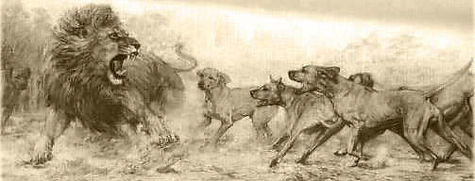
The dogs resulting from these crosses were widely used by hunters, particularly in the regions of Zimbabwe (Rhodesia) and Botswana. They hunted in groups of 3 to 4 dogs (ridgeback dogs) and had the endurance and agility to bay and corner a lion, which would later be shot by the hunter.
In 1924, the first Rhodesian Ridgebacks were registered with the Kennel Union of Southern Africa (KUSA), using the Dalmatian standard as a baseline to define the breed standard.
BREED STANDARD
The Rhodesian Ridgeback should represent a strong, agile, active, and symmetrical dog. It should possess great endurance and speed. The musculature should not be exaggerated.
The ridge on the back, characteristic of the breed, must be clearly defined and symmetrical, featuring two identical and opposite crowns. The lower edges of the crowns should not extend lower down the ridge than one-third of its total length. Various shapes of accepted ridges exist (see image below).

Image by Vanessa Moyano, El Rhodesian Ridgeback
Ridgelessness:
Occasionally, puppies with and without ridges can be born within the same litter. The presence of a ridge depends on the genetic factors of the parents. Put simply, ridgelessness occurs when a combination of recessive genes from both the sire and dam comes together. Two ridged parents can produce puppies with and without ridges, as illustrated in the grid below.
The absence of a ridge precludes participation in dog shows, and ridgeless dogs should not be used for breeding.
This condition has no negative impact on the animals' health—quite the contrary: the likelihood of developing a dermoid sinus (a relatively common condition in Rhodesian Ridgebacks) is significantly reduced in ridgeless dogs. For more information on this topic, refer to the article: https://www.rhodesian-ridgeback-pedigree.org/articles-informations/breeding-and-genetics/avoiding-the-gene-defect-ds/
Coat and Size:
Regarding coat color, it should range from light wheat/gold to red wheaten. White hairs should be minimal and are permitted on the toes and chest. Excessive white hairs on the abdomen or above the toes are undesirable. Black hairs are highly undesirable throughout the body, except on the muzzle and ears, which may have a darker color.
Height:
-
Males: 63 – 69 cm
-
Females: 61 – 66 cm
Weight:
-
Males: approximately 36.5 kg
-
Females: approximately 32 kg
TEMPERAMENT
Intelligent, an excellent watchdog, and a wonderful family companion that is gentle and careful with children. It is loyal and reserved with strangers. It has the distinct trait of rarely barking. It is active and enjoys exercise, yet remains calm indoors. It possesses a strong hunting instinct. It is easily trained, though it can show a stubborn streak.
HEALTH
The Rhodesian Ridgeback is a hardy and healthy dog, with relatively few congenital issues in the breed. However, awareness is required regarding the incidence of dermoid sinus, which originates during embryonic development as a failure of complete separation between the neural tube and the epidermis. It is a hereditary condition that predominantly affects this breed. Additionally, due primarily to being a large-breed dog, screenable conditions such as hip and elbow dysplasia must be monitored, as they can cause reduced exercise tolerance and pain.
Caption:
In the figure, "R" represents the dominant gene for the presence of the ridge and "r" the recessive gene for the absence of the ridge. Thus, there are 3 possible genetic combinations:
R/R - dog with a ridge and both genes dominant.
R/r - dog with a ridge but only with one dominant gene.
r/r - ridgeless dog, without the dominant gene
Depending on the crossbreeding, the following results can be obtained:
R/R x R/R: all descendants are R/R and ridged.
R/R x R/r: 50%* R/R 50%* R/r - all ridged
R/R x r/r: all R/r descendants ridged
R/r x R/r: 25%*R/R, 50%*R/r (75%* ridged) 25%*r/r ridgeless
R/r x r/r: 50%*R/r ridged and 50%*r/r ridgeless
r/r x r/r: all r/r descendants ridgeless
* statistical value/probability


Caption: Showing both Ridged and Ridgeless Rhodesian Ridgebacks Source: https://gesunde-ridgeback-zucht.de/